"Malvinas: environmental present and future"

Collab: Carolina Somoza, B.A. in Political Science (University of Buenos Aires), holds diplomas in Environmental Law, the Rights of Migrants and Refugees, and Comprehensive Environmental Education. Teacher and serves as an advisor at the Office of the Ombudsperson (Autonomous City of Buenos Aires).
Every April 2nd we return to the topic of the Malvinas. We usually approach it through historical memory, recognition of veterans, and the debate over sovereignty. And that matters. But there is another dimension that appears less often in public conversation: the environmental one. Thinking about the Malvinas also means thinking about their ecosystems. Because beyond political positions the islands are part of a strategically important environmental region: the South Atlantic. And what happens there has impacts far beyond its shores.

Photo: Nicky Souness.
A territory of high environmental value:
The Malvinas Islands are part of one of the most sensitive environments on the planet. They are home to a wide variety of marine and land species, many of them protected or of special scientific interest: penguins, sea lions, elephant seals, migratory birds, and rich marine life. The ocean surrounding the islands is one of the most biologically rich in the world and for that reason one of the most sought after.
One lesser known example of environmental impact is the case of the “Malvinas Islands wolf". This species was driven to extinction after being seen as a threat to sheep farming. Today one of the few remaining specimens can be seen at the Natural History Museum in London. This highlights an important idea: beyond who administers the territory, what truly matters is how natural resources are managed and what environmental standards are applied.
A clear example is Overfishing. Licenses are granted in the surrounding waters allowing foreign fleets to operate in the region. This is not only an economic issue it can also affect the balance of species and marine food chains if it is not managed carefully. Overfishing has already had serious impacts on species in the South Atlantic. And when a species is affected, it is not just “one fish” that disappear the balance of the entire ocean ecosystem can be disrupted, including predators and coastal communities that depend on these "resources". In other words, this is not only about resources it is about the environmental future of the region.
Oil in the South Atlantic: a direct threat:
Another issue that is rarely discussed is oil exploration. Over the years, projects have been authorized in the Malvinas area, and companies have drilled the seabed in search of oil in a very fragile environment. This raises serious concerns for several reasons. First because it is a disputed territory. Second because any oil spill in the South Atlantic could become a major environmental disaster. This is not like the Gulf of Mexico, where there is strong infrastructure to respond to accidents. This is a remote region with harsh conditions where a spill could damage ecosystems for decades.

Photo: Manda Lundström.
Sovereignty is also environmental:
The Malvinas issue is often discussed mainly from a political or historical point of view. But it can also be understood from an environmental perspective, which is becoming increasingly important. Talking about sovereignty today is not only about territory it is also about the ability to protect ecosystems manage natural resources and choose sustainable ways of development. This requires environmental policies, scientific research, and clear rules to protect the environment.
Argentina has environmental laws, takes part in international agreements, and supports research on marine ecosystems. Strengthening and expanding this work is part of today’s challenges.
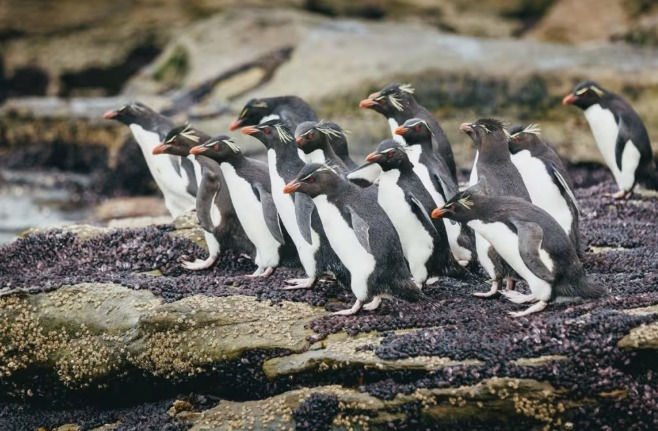
Photo: David Merron.
Malvinas and environmental governance:
Managing territories like this involves clear responsibilities especially when dealing with sensitive environments. Activities such as fishing or oil exploration can have significant impacts if they are not carried out under strong sustainability standards. That’s why beyond political positions it is important to focus on how decisions are made what controls are in place, and what priorities are set for protecting the environment. Principles such as sustainable development, protection of wildlife, and responsible use of natural resources are widely recognized around the world and should guide activities in areas like this.
Memory and environmental awareness:
April 2nd is, above all, a day of remembrance. But it can also be an opportunity to reflect on the present and future of the South Atlantic environment.
Thinking about sovereignty from an environmental perspective also means recognizing that:
Taking care of natural resources is part of development.
Protecting ecosystems is a long-term responsibility.
Deciding how resources are used is a shared responsibility.

Photo: David Merron.
Why talk about the Islands Malvinas from an environmental perspective?:
Today it is clear that natural resources and biodiversity are becoming more and more important around the world. In this context, regions like the South Atlantic are gaining increasing attention. Talking about the Malvinas from an environmental perspective also means thinking about:
Marine conservation.
Scientific research.
Longterm sustainability.
Ensuring that this environment is protected for future generations.
Adding the environmental perspective opens a broader space for reflection one that goes beyond positions and focuses on a shared concern: caring for the environment. Because protecting ecosystems is not only about the present it is also about building the future. And healing also means protecting the environment #ForABetterWorld .The Malvinas are not only about the past. They are not only about memory. They are also about the environment. And they are also about the future.
Bibliography:
Ministry of Foreign Affairs, International Trade and Worship of the Argentine Republic. Malvinas Question.
United Nations. Resolutions of the Decolonization Committee on the Malvinas Islands.
National Scientific and Technical Research Council (CONICET). Reports on South Atlantic Marine Biodiversity.
National Institute for Fisheries Research and Development (INIDEP). Reports on Fishing in the South Atlantic.
Secretariat of Environment of Argentina. Reports on Marine Biodiversity.
Malvinas Observatory – National University of Lanús.
Greenpeace Argentina. Reports on Illegal Fishing and Ocean Protection.
Fundación Vida Silvestre Argentina (Argentine Wildlife Foundation). Reports on Marine Biodiversity and Protected Species.
Malvinas Islands Veterans Center (CECIM La Plata).
International Treaties on Marine Biodiversity (United Nations, Convention on Biological Diversity).
Infobae. “The story of the Malvinas Islands wolf: evidence of Argentina’s sovereignty in the islands.” https://www.infobae.com/america/perrosygatos/2021/02/18/la-historia-del-zorro-malvinero-una-prueba-de-nuestra-soberania-en-las-islas/


Comments