Lithium Triangle: Thinking the future from the territories.
Collab: Members of the Indigenous Delegation participating in the United Nations Permanent Forum on Indigenous Issues. Press coordination: Mariana Sturniolo.
Indigenous representatives from Argentina Bolivia and Chile shared their reflections at the United Nations Permanent Forum on Indigenous Issues on water "highandean ecosystems" and the challenges of building a sustainable future for all #ForABetterWorld.
We live in a time of major transformations. The search for cleaner energy, technological advancement, and the need to address the environmental challenges of the 21st century present opportunities that, until a few years ago seemed unthinkable. However they also invite us to ask important questions: How do we build that future? What factors must we consider for development to be truly sustainable? How do we find a balance between progress, the protection of nature, and the well-being of communities?.

Luisa Casimiro, Albert K. Barume y Clemente Flores
Within the framework of the 25th United Nations Permanent Forum on Indigenous Issues held in New York a delegation composed of Indigenous representatives from Argentina Bolivia and Chile shared their perspective on "highandean salt flats" ("salares") water resources, and the challenges faced by a region that is key to the global energy debate.
Beyond the different positions that may exist on these issues listening to the experiences of those who inhabit these territories helps enrich the conversation and better understand the complexity of current challenges. Thinking about the future means not only asking what resources we need, but also how to manage them in a responsible transparent and respectful way toward people and ecosystems.
At Environmental & + we believe that environmental education dialogue and the exchange of ideas are essential tools for building a more conscious society capable of finding solutions that integrate development innovation environmental protection and quality of life for present and future generations.

What are the main environmental concerns that bring you to the Forum regarding lithium expansion in "highandean salt flats"?: Our main concern is that lithium expansion is taking place in extremely fragile ecosystems such as salt flats "highandean wetlands" and water basins that sustain life in our territories. We are witnessing a profound alteration of these systems due to the intensive extraction of brine the lack of independent environmental information and the absence of comprehensive assessments of cumulative impacts. We come to the Forum to warn that the energy transition cannot be built at the expense of new territorial sacrifices for Indigenous peoples.
What importance does access to and protection of water have in the territories where these projects are developed?: Water is at the center of life in our territories. In the "highandean salt flats" there is no separation between water biodiversity culture and community. Lithium extraction consumes large amounts of water in areas where this resource is scarce putting at risk not only our livelihoods but also ancestral and spiritual practices. Defending water means defending our existence as peoples.
How do you describe the relationship between healthy ecosystems and community well-being?: For our peoples, community health is inseparable from ecosystem health. When a wetland degrades, when water decreases or when a salt flat loses its balance our physical spiritual and cultural health is also affected. Our territories are not only productive spaces; they are spaces of life.
What role do you consider key to guaranteeing the right to prior consultation in these types of projects?: The key role must be assumed by States as they are responsible for ensuring the right to free prior and informed consultation in accordance with international standards. They also consider it essential that monitoring mechanisms and effective participation processes are in place so that communities can be involved in decisions affecting their territories.
What do you hope to highlight at the United Nations Forum regarding the environmental and territorial situation of the Lithium Triangle?: We aim to highlight that in the Lithium Triangle there is a shared situation among communities in Argentina Bolivia and Chile: extractive pressure on our territories is advancing faster than the protection of our rights. We seek to show that this is not only a discussion about strategic minerals but also about water biodiversity ancestral cultures and ways of life that form part of the heritage of our territories.
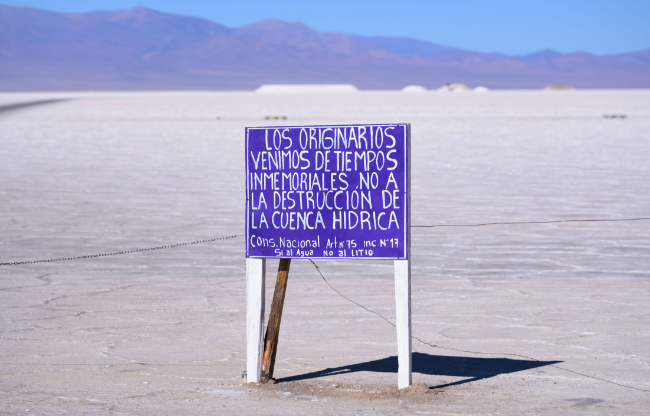
Every time we use a mobile phone a laptop or talk about electric vehicles there is something that often goes unnoticed: a large part of the minerals driving this energy transition come from territories such as the Lithium Triangle where Argentina plays a key global role.
For this reason the debate on lithium goes far beyond economics or technology. It also invites us to think about how the future is being built in a world that needs to change and what role territories water and communities play in those decisions. Listening to what happens in these places does not close the debate: it opens it more deeply.
We thank all participants:
Clemente Flores (Argentina, Kolla people). www.salinasgrandes.org
Luisa Casimiro (Argentina, Lickanantay people)
Williams Colque (Bolivia)
Faviola González Soto (Chile)
José Torres Burgos (Chile)
Rosa Mamani Quispe (Bolivia)
Mariana Sturniolo: Communication and press coordination

Comments